
Views: 0 Author: Site Editor Publish Time: 2026-09-09 Origin: Site


Upgrading or establishing a cordage manufacturing line requires absolute precision. Plant managers face a critical choice between standard 3-strand and specialized 4-strand configurations. This single decision dictates future manufacturing capabilities on the factory floor. It fundamentally shapes your production output.
Selecting the wrong machine geometry impacts production bottlenecks directly. It limits target market applications and often increases unnecessary maintenance overhead for your maintenance crews. Manufacturers simply cannot afford mismatched equipment in today’s highly competitive industrial cordage landscape. You need a reliable technical baseline to justify equipment acquisitions.
We aim to provide plant managers and procurement teams an evidence-based comparison. You will explore structural outputs, operational efficiency, and real-world implementation realities. We outline exact mechanical differences and maintenance expectations. This detailed guide helps you confidently navigate your purchasing decision.
Structural Output: 3-strand machines produce general-purpose cordage rapidly; 4-strand machines require a core-feeding mechanism but yield rope with higher surface-contact and abrasion resistance.
Operational Efficiency: A 3 strand rope machine generally offers higher throughput and easier tension calibration due to simpler mechanical geometry.
Capital & Maintenance: A 4 strand rope machine carries a higher initial CapEx and requires more rigorous maintenance schedules for the additional bobbin carrier and core-feed synchronization.
Market Alignment: Choose based on end-user application (e.g., general marine/agriculture for 3-strand vs. high-abrasion/power transmission for 4-strand).
Evaluating industrial twisted rope equipment begins by analyzing the core engineering differences. You must understand the mechanical trajectory of the bobbins. Three-carrier systems use a highly efficient planetary or tubular rotation. They spin three bobbins around a central axis seamlessly. This simplicity reduces internal friction.
Four-carrier systems require complex synchronized gearing. This advanced gearing accommodates the fourth strand without causing catastrophic tangling. The rope structure fundamentally changes here. A four-strand configuration requires a central core, commonly known as heart yarn. This core maintains the rope's shape. It prevents internal collapse under heavy tension. Consequently, operators must use an independent tensioned feeding mechanism on the machine itself.
Let us compare footprint and power requirements. A four-strand setup carries a heavier flyer and an additional carrier payload. It requires a significantly larger physical footprint on your factory floor. You also need a larger motor to drive the heavier rotating mass. Increased power requirements demand robust electrical infrastructure. Plant managers must accommodate higher amperage draws during initial equipment startup. Standard three-carrier units utilize smaller motors and fit into tighter production layouts easily.
Common mistake: Facilities often underestimate the required concrete floor loading for four-carrier machines. The heavier rotational mass creates localized vibration. You must bolt these machines into reinforced concrete pads to ensure operational stability.
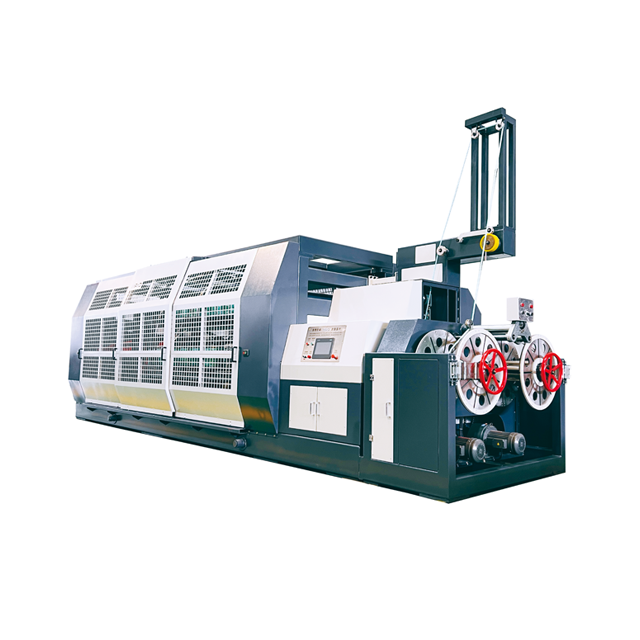
Throughput and speed define the operational advantages of standard three-carrier setups. The flyer head remains lighter and aerodynamically simpler. This allows a 3 strand rope machine to achieve remarkable rotational speeds. Higher RPM capabilities translate directly to higher daily production yields. Facilities running continuous shifts benefit immensely from this rapid extrusion pace.
Operator training represents another massive advantage. Your workforce faces a much lower learning curve. Threading the machine takes less time. Tensioning the individual strands requires fewer complex adjustments. Daily changeovers happen swiftly. This mechanical simplicity reduces expensive downtime significantly. New operators achieve baseline competency in days rather than weeks.
Consider the yield-to-cost ratio for this equipment. This configuration absolutely dominates high-volume, cost-sensitive markets. Examples include basic packaging twine, standard agricultural ropes, and entry-level mooring lines. These markets demand sheer volume over specialized structural properties. The three-strand format delivers acceptable breaking strength at an optimal production cost.
However, you must acknowledge certain manufacturing limitations. A three-strand output lacks the end-product flexibility found in multi-strand alternatives. The surface smoothness remains slightly inferior. You will notice pronounced ridges between the strands. This textured profile can cause accelerated wear when running through specialized marine pulleys. It also offers slightly less abrasion resistance in highly abrasive environments.
What are the end-product advantages of a four-carrier system? A four-strand output creates a noticeably rounder physical profile. This cylindrical shape provides greater surface area for sheave and pulley contact. It drastically reduces internal abrasion during cyclic loading. End-users benefit from superior fatigue resistance. The embedded core also minimizes hazardous stretch during heavy lifting operations.
Mechanical complexity increases significantly to achieve these benefits. A 4 strand rope machine demands precise tension control for the central core strand. The core must feed at a perfectly synchronized rate. If operators miscalibrate this core tension, the final rope will deform. You will see hollowing defects where the outer strands collapse inward. You may also experience core-popping, where the core breaks through the outer jacket.
Factor in the increased maintenance overhead immediately. The heavier rotational mass and tighter operational tolerances cause faster wear. Gears, heavy-duty bearings, and slip rings require frequent inspection. Maintenance crews must lubricate planetary gears meticulously. You cannot skip preventative maintenance schedules. Neglect leads to catastrophic bearing failures and extended machine downtime.
You must target premium ROI applications to justify these operational complexities. Focus your sales efforts on architectural rigging, heavy-duty towing, and specialized marine environments. These high-margin markets eagerly absorb the higher manufacturing expenses. Buyers in these sectors demand the specific load-bearing characteristics and abrasion resistance provided by four-strand configurations.
Comparing an industrial rope making machine requires evaluating several distinct operational pillars. You must assess initial expenditure, process scalability, and material handling capabilities.
Compare upfront machine costs carefully. Four-strand units require heavier investments upfront due to the extra carrier and complex gearing. Tooling expenses also differ widely between models. You must evaluate the ongoing energy consumption per kilogram of extruded or twisted rope. Three-strand models consume less electricity daily. Their lighter moving parts require smaller drive motors. Four-strand operations generate higher monthly utility bills. You must offset these energy costs with higher final product pricing.
Analyze the expected downtime required to change manufacturing parameters. Changing pitch or twist direction introduces delays. Moving from an S-twist to a Z-twist requires complete mechanical recalibration. Adjusting strand diameters takes slightly longer on complex four-carrier setups. Operators must recalibrate the core tensioning brake during every diameter change. Three-strand setups allow for rapid, agile changeovers.
Follow these best practices for efficient changeovers:
Document the exact tension brake settings for every specific rope diameter.
Stage the pre-twisted yarn bobbins near the machine before stopping the current run.
Inspect the flyer head guides for polymer buildup during the changeover window.
Run a short ten-meter test batch to verify pitch consistency before resuming full speed.
Assess how each machine handles different raw polymers. Your equipment must process Polypropylene, Nylon, and UHMWPE seamlessly. Natural fibers present unique friction-heat management issues. Hemp and sisal shed abrasive dust during the twisting process. This dust infiltrates bearings and optical sensors. You must control twisting temperatures carefully to prevent synthetic fiber degradation. Four-strand units often generate more friction heat due to the tighter structural compaction.
Keep these material handling guidelines in mind:
Polypropylene requires moderate tension to prevent stretching before the final twist.
Nylon generates significant static electricity; ensure your machine features proper grounding rods.
Natural fibers demand frequent machine vacuuming to prevent dust-induced sensor failures.
UHMWPE requires specialized smooth ceramic guides to prevent micro-abrasions on the yarn.
Equipment Capability Comparison
Feature Category | 3-Strand Configuration | 4-Strand Configuration |
|---|---|---|
Production Speed | High (150-200+ RPM) | Moderate (Due to heavier flyer mass) |
Rope Profile | Ridged, standard geometry | Rounder, high surface contact area |
Core Requirement | None | Mandatory (Heart Yarn) |
Operator Learning Curve | Low (Standardized threading) | High (Complex core tensioning) |
Target Markets | Agriculture, packaging, basic marine | Heavy towing, architectural rigging |
Plant managers must evaluate supply chain risks before finalizing a purchase. Highlight the risk of proprietary gearing in advanced four-strand units. Three-strand units usually rely on standardized, off-the-shelf mechanical components. Supply chain disruptions affect proprietary parts much harder. If a specialized four-strand planetary gear breaks, you might wait weeks for an international replacement. Always secure a comprehensive spare parts kit during the initial procurement phase.
Advise your engineering buyers to evaluate tension brakes rigorously. Test both mechanical and electronic servo-driven systems during Factory Acceptance Testing (FAT). You must verify that the core tension remains completely stable at maximum RPM. Request a sustained two-hour test run. Watch closely for any tension fluctuations. Unstable tensioning systems ruin miles of cordage quickly.
Review necessary safety shielding and compliance parameters. Acoustic enclosures are virtually mandatory for larger models. High-speed twisting generates significant decibel levels on the factory floor. Automatic shut-off sensors are critical for protecting the equipment. However, strand-break detectors often experience false-tripping on complex four-strand setups. You must calibrate these optical sensors perfectly. Natural fiber dust or minor synthetic vibrations can trigger unnecessary emergency stops. Clean these sensors daily to maintain peak production efficiency.
Summarize the final assessment logic clearly. The choice is rarely about which machine is inherently better. Instead, determine which unit aligns perfectly with your target market margins. You must also consider your existing operator technical capability. A three-strand unit provides reliable, high-speed output for volume-driven markets. A four-strand unit offers premium structural properties for high-margin industrial applications.
Take actionable next steps immediately. Recommend auditing your current production bottlenecks first. Request physical sample runs from equipment vendors using your specific yarn. Calculate the exact operational cost-per-meter based on local energy rates and labor costs. Finalize these internal evaluations thoroughly before issuing an official RFP to your shortlisted machinery suppliers.
A: Mechanically possible on some advanced servo-driven models by removing a carrier, but highly inefficient and often results in unbalanced flyer rotation causing severe bearing wear. It is not recommended for sustained production.
A: No. Both machine types require pre-twisted yarns or strands. The equipment is strictly for the final forming and twisting stage of cordage manufacturing.
A: Depending on the take-up winder capacity and core-creel feeding station, a 4-strand setup typically requires 15% to 25% more linear floorspace than an equivalent 3-strand model.
A: Assuming identical material and overall diameter, 3-strand rope generally has a slightly higher breaking strength. However, 4-strand offers superior abrasion resistance and elongation characteristics, making it better for specific load-bearing applications.