
Views: 0 Author: Site Editor Publish Time: 2026-11-14 Origin: Site


Polymer extruders crave non-stop, steady-state operation. Downstream winding systems require periodic halts for necessary bobbin swaps. This fundamental conflict creates massive headaches for production engineers. Every single pause drives continuous production costs higher. Extrusion dies suffer tremendously when machines slow down or stop completely. Polymer melt begins degrading thermally inside the hot barrel. Wall thickness variations rapidly ruin structural product quality metrics. Dangerous pressure surges occur randomly across heated manifold zones. Furthermore, machine operators generate significant scrap volume during these frustrating restart phases.
Yarn accumulation technology solves this severe operational mismatch perfectly. These specialized systems function as dynamic physical buffers on your factory floor. They decouple your continuous upstream line speed from batch downstream take-up cycles. You can execute full bobbin transitions seamlessly without halting polymer flow.
This guide explores the complex operating mechanics of modern yarn accumulation systems. We examine crucial technical evaluation criteria alongside base operating principles. You will learn advanced integration tactics for automated winding machinery. Finally, we provide proven strategies to calculate investment payback for plant operators.
Decouples steady-state polymer extrusion from downstream packaging cycles, eliminating thermal shock and melt pressure fluctuations.
Leverages closed-loop servo-driven festoons to store dozens of meters of filament without introducing tension variance.
Synchronizes with downstream equipment through automated speed differential recovery cycles once a bobbin swap concludes.
Requires precise alignment with specific filament characteristics (denier, elasticity, surface friction) to prevent filament damage or slack.
Justifies capital expenditure by slashing line purge waste, reducing startup scrap, and increasing overall equipment effectiveness (OEE).
Polymer melt stability demands constant baseline equilibrium throughout the entire manufacturing line. Extrusion setups need precise internal die pressure to maintain filament integrity. Barrel temperature parameters and throughput velocity must remain absolute constants. Pausing an active extrusion line violently disrupts these delicate physical balances. Decelerating master speeds cause molten resin to overheat rapidly against barrel walls. Melt fractures appear visibly along tape or monofilament extrusion profiles. Severe denier variance spikes unpredictably across hundreds of meters of extruded material. Physical thermal laws do not allow fast stops without introducing material product degradation. Production teams inevitably sacrifice continuous output quality when conventional winders pause.
Downstream changeovers create a staggering volume of daily cumulative factory waste. Operators observe these mechanical losses operating in two distinct operational categories.
Direct material losses impact profit margins and yield metrics immediately. Extruders dump unspooled waste yarn haphazardly onto the factory floor. Production lines push out vast quantities of off-spec startup product during re-acceleration. Facilities consume expensive purge material constantly while trying to restart extrusion lines cleanly.
Indirect performance losses damage long-term plant efficiency invisibly. Frequent process stops mandate heavy operator intervention overhead per shift. Heaters waste immense electrical energy trying to reestablish core thermal equilibrium. Continuous pressure cycling severely shortens expensive screw and barrel lifespan over several years.
A successful modern extrusion operation requires an exceptionally seamless material buffering strategy. Process engineers evaluate accumulation performance using three essential manufacturing success criteria:
Continuous 100% extruder throughput velocity during all downstream package transfers.
Zero out-of-tolerance physical tension spikes applied to the moving yarn bundle during fill or discharge.
Seamless automated handoffs between primary line drives, accumulator dancers, and terminal take-up units.
Your production line should literally never know a bobbin swap is actively happening.
A High Capacity Accumulator Machine utilizes a highly specialized multi-pass moving carriage system. They feature a combination of stationary and dynamically traveling roller banks. The traveling bank extends smoothly away from the fixed stationary rollers. This mechanical action increases the linear travel path length of the active yarn exponentially.
Process engineers calculate baseline storage capacity utilizing simple production math. They multiply core line speed (m/min) by the necessary required swap time (minutes). This baseline equation strictly dictates minimum mechanical accumulator dimensions. Facility layout realities heavily influence your structural space optimization strategy. Vertical tower arrays fit extremely narrow floor footprints but need tall high ceilings. Low-profile horizontal track systems consume more floor aisle space but fit under restrictive structural headers safely.
Yarn entering a mechanical buffer requires absolutely perfect real-time tension control. Top systems use tightly integrated pneumatic and electronic dancer arms. These sensitive dancers counteract native mechanical inertia as traveling yarn rapidly fills the roller bank.
The system transition phase ultimately dictates your final spool quality. Your architecture must shift perfectly from a steady-state bypass into full accumulation mode. Precise software programming completely eliminates dangerous mid-process tension dips. Sudden material slack causes filaments to wander sideways or jump completely off tracking guides.
Manufacturers often specify proprietary ceramic guide low-friction rollers. Dense ceramic construction mitigates latent static electricity buildup highly effectively. These specialized rounded rollers also prevent delicate fibrillated filament flattening during prolonged stationary storage retention.
Once line operators successfully complete a manual bobbin swap, the system must empty itself. Advanced post-swap draw-down mechanics tightly govern this critical evacuation step. Downstream take-up units accelerate deliberately far above steady upstream line speeds. This controlled over-speed condition depletes previously stored yarn very gradually.
The buffering carriage then executes a remarkably slow return-to-home cycle. Fast carriage returns generate incredibly dangerous downstream tension spikes. Gradual resets ensure predictably smooth torque transitions. They effectively protect newly loaded package cores from aggressive over-tensioning.
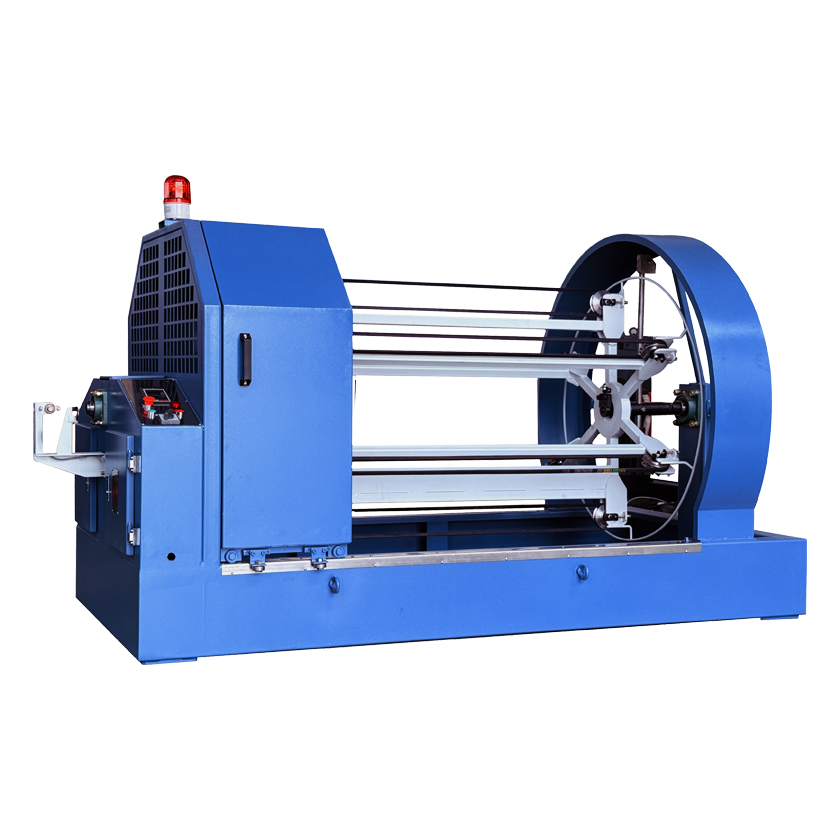
Connecting buffering accumulators to modern winding technology introduces complex synchronization challenges immediately. A High Speed Spool Winding Machine must match storage release rates absolutely flawlessly. Programmable logic controllers tie physical buffer capacity directly into automated turret indexers and expanding spool chucks.
Spool traverse mechanisms face intense operational stress during the aggressive draw-down phase. The downstream take-up accelerates dramatically to clear loaded buffer storage rapidly. Active traverse speeds must scale proportionally to maintain a precise wind geometry package. Multi-end extrusion profiles amplify these tracking difficulties tremendously. The active buffer must smoothly handle several independent strands simultaneously. Cross-strand entanglement often ruins entire production runs if tracking guides lack adequate physical spacing. Individual loop tension controls prevent destructive differential pulling across closely grouped spools.
Consumer twines and heavy tape balls use radically different industrial packaging steps. A High Speed Ball Winder Machine executes incredibly aggressive mechanical cut-and-transfer actions. Constant buffer management acts as an essential lifeline during these harsh mechanical transitions.
Industrial twines and cords frequently undergo intermittent stop-and-drop packaging cycles. The main take-up head stops completely to drop a fully finished ball. High-capacity material buffers absorb these sudden mechanical halts instantly. They actively shield the highly delicate upstream extrusion die from violent tension shocks. Upstream extruders keep pushing melt continuously and safely behind the moving buffer shield.
Modern extrusion facilities rely heavily on intelligent PLC control architectures. Connecting an advanced Automatic Ball Winder Machine requires establishing highly complex digital communication handshakes.
Digital systems link upstream extruder velocity sensors directly to accumulator fill-level encoders. Master PLCs read these constant inputs and trigger precise winder synchronization cycles. Engineers build remarkably robust fail-safe protocols into these logic programming loops. Sometimes a robotic bobbin swap fails or jams quite unexpectedly. If the active swap duration exceeds maximum physical accumulator carriage travel, safety logic takes over. The master controller instantly triggers automated emergency dump sequences. It simultaneously initiates structured line shutdown procedures to prevent catastrophic upstream equipment damage.
You must assess baseline line speed compatibility accurately before beginning vendor shortlisting. High-output processing lines pushing 600+ m/min demand massive carriage travel expansion limits. Much slower 200 m/min tape lines fit easily inside significantly smaller spatial footprints.
Evaluate exact material denier handling capabilities extremely carefully. Delicate medical monofilaments require ultra-light precision tension loops. High-tenacity industrial lifting tapes need robust bearings and much heavier steel frames. Multi-ply fibrillated yarns easily trap ambient air and twist terribly during travel. Always match internal roller profiles perfectly to your specific yarn friction characteristics.
Internal tension architecture completely defines your final product consistency. Many older buffering systems use rudimentary mechanical counterweights. We strongly advise examining their inherent operational limitations. Static counterweights suffer from severe mechanical inertial lag during sudden speed shifts.
Electronic servo dancers provide distinctly superior operational advantages. Servo-driven electronic load-cell systems offer incredible real-time sub-gram precision. They deliver instantaneous dynamic torque compensation across highly unpredictable extruder pressure surges. Plant operators easily utilize custom recipe-driven tension storage profiles for varying product lines.
System Feature | Mechanical Counterweights | Electronic Servo Dancers |
|---|---|---|
Response Time | Noticeably Slow (Inertial Lag) | Practically Instantaneous |
Control Precision | Moderate (Friction Losses Present) | Extreme Sub-gram Accuracy |
Changeover Agility | Manual Weight Repositioning Required | Digital Recipe-Driven Screen Controls |
Structural Complexity | Very Simple Mechanical Setup | Complex Software and Sensor Integration |
Best Suited Application | Thick, heavy high-tenacity ropes | Delicate, high-speed thin monofilaments |
Tight space constraints often force difficult factory engineering trade-offs. Vertical buffer towers offer much lower ground floor footprints. They strictly demand extensive ceiling height structural clearance, however. Horizontal tracking frames eat highly valuable aisle space but fit perfectly underneath low support beams.
Evaluate daily equipment threading usability very closely. Look exclusively for rapid ergonomic string-up capabilities. Open-sided roller banks improve single-operator string-up ergonomics immensely. Top-tier industry designs feature smart pneumatic threading assists to propel yarns safely forward.
Buffer carriages live constantly in a punishing high-frequency reciprocating environment. Evaluate listed mechanical bearing life ratings rigorously. Constant starting, stopping, and reversing wears inferior bearing components surprisingly rapidly.
Assess electrical anti-static bar integration carefully. Tape or flat film extrusion inherently generates massive static surface charges. Well-placed vacuum dust extraction points keep continuous raffia lines humming beautifully and cleanly.
Facility engineers consistently face complex mechanical risks during initial commissioning phases. Multi-roller accumulator configurations frequently induce terrible structural yarn twist. Excessive geometric wrap angles introduce tremendous hidden structural stress to delicate plastic filaments.
Fast-spinning non-driven idlers always pose hidden processing dangers. They generate intense unseen friction heat during high-speed yarn evacuation sequences. This accumulated heat transfers onto sensitive coatings or degrades underlying polymer tensile strength.
Electrical synchronization lag creates completely miserable production days. Accumulators occasionally "bottom out" abruptly if digital PID loops lag behind mechanical realities. Poor drive tuning causes the downstream winder to over-pull violently against the main extruder.
Factory workers often fear massive high-travel carriage mechanisms intuitively. Automated rapid structural motion requires exceptionally strict machine safety guarding. Implement robust physical steel barriers alongside highly sensitive laser light curtains. Proper electronic guarding protects maintenance technicians flawlessly during unexpected emergency releases.
Sensor calibration routines matter immensely for long-term reliability. Plant managers must aggressively schedule regular weekly encoder checks. Uncalibrated proximity sensors cause dangerous carriage drift slowly over a working week. Small drift triggers false buffer-full signals and shuts down lines totally unnecessarily. Operators quickly lose baseline trust in uncalibrated, erratic machinery.
Major engineering projects die quickly without solid financial justification models. You can estimate concrete OEE (Overall Equipment Effectiveness) gains using a fairly simple mechanism. Use this core calculation formula to model your daily production returns:
(Daily Changeovers × Actual Scrap Meterage Saved) + Extruder Uptime Recovery Minutes.
High-speed continuous packaging lines boast highly realistic, aggressive financial ROI timelines. Automated buffering slashes raw material purge waste almost instantly. Compare your new projected minimal scrap rate against existing manual changeover baselines. You will reliably discover millions of saved production meters annually.
Continuous polymer extrusion demands highly intelligent dynamic buffering hardware. Non-stop polymer processing naturally conflicts directly with modern batch winding automation cycles. You must deploy robust accumulators to harmonize these two opposing mechanical forces perfectly.
Selecting correct accumulation systems requires meticulous factory alignment. Match your core line velocity precisely against heavily required post-swap catch-up speeds. Understand specific yarn sensitivity profiles accurately to specify optimal roller surface coatings. Ultimate tension control drives your final product quality metrics directly.
Facility engineering teams face very clear action steps moving forward. First, diligently audit your existing manual bobbin cycle durations. Quantify all daily machine purge scrap volumes extremely meticulously. Finally, accurately model ideal buffer storage capacity targets before beginning your official vendor shortlisting process.
A: Practical capacity ranges between 30 and 180 seconds of active production storage. Actual functional buffer time depends heavily on your specific line velocity and physical plant footprint constraints. Highly synchronized winder swap automation typically demands far less storage time, allowing for much smaller accumulator carriage designs.
A: Yes, it absolutely can if roller inertia or friction is mismanaged within the system. Low-inertia ceramic or carbon-coated rollers naturally prevent these frustrating defects. Utilizing precise servo-controlled tension loops successfully mitigates harsh surface abrasion or unexpected filament elongation during high-speed transitions.
A: The downstream automated winder runs at a carefully calculated overspeed margin. This take-up speed runs typically 10% to 25% faster than baseline extrusion line speed. This aggressive acceleration draws down the stored yarn rapidly until the accumulator carriage returns safely to its empty resting position.
A: Yes. While advanced automatic winders reduce changeover intervals significantly, accumulators still serve as absolutely critical safety margins. They safely absorb massive production volumes during unpredictable splice failures, missed catches, or unexpected roll rejections. They effectively protect the delicate extrusion die from stopping unexpectedly during winder faults.