
Views: 0 Author: Site Editor Publish Time: 2026-10-26 Origin: Site


The global demand for durable, weather-resistant ropes across industrial sectors such as agriculture, marine logistics, commercial fishing, and packaging is skyrocketing. For facility owners and ambitious entrepreneurs, stepping into the plastic cordage manufacturing sector often feels like navigating a complex maze. You might find yourself wondering what specific machinery is actually required. How much factory floor space do you need to lease? What does the realistic return on investment look like on the factory floor?
This comprehensive guide systematically demystifies the entire setup process. From mastering the precise thermal nuances of polymer extrusion to accurately projecting your financial break-even point, you will discover exactly what it takes to launch a highly efficient manufacturing facility. Before diving into technical specifications and optimal factory layouts, let us first examine the foundational economic drivers and current trends shaping this thriving industry.
Entering the synthetic cordage sector represents a strategic investment in a consumable product with consistent, year-round demand. Industrial ropes are unglamorous yet absolute necessities. They wear out, fray, and snap under immense pressure. The continuous need to replace these lines ensures a recurring revenue model for manufacturers.
Looking at the current industrial landscape, the global market for synthetic ropes is experiencing a significant upward trajectory. Recent global supply chain disruptions have forced a massive shift toward localized manufacturing. Regional distributors are actively seeking domestic rope suppliers to completely bypass exorbitant international shipping delays. Furthermore, the rapid expansion of modern aquaculture and deep-sea fishing creates a massive, continuous need for UV-resistant netting and heavy-duty mooring lines.
Concurrently, there is a powerful push toward sustainability. Advanced production facilities are beginning to blend high-grade recycled ocean plastics with virgin polymers. This strategic material blending meets stringent environmental standards while maintaining robust profit margins, keeping manufacturers highly competitive.
Selecting the correct polymer is critical for targeting specific industry niches. Fortunately, modern extrusion equipment is highly versatile. Operators can process both materials with only minor thermal and mechanical calibration on the factory floor.
Polypropylene, commonly known as PP, is characterized by its lightweight nature. It floats on water and boasts excellent chemical resistance against acids and alkalis. It remains the premier choice for marine mooring lines, general utility tie-downs, and logistics cargo securing.
In contrast, Polyethylene, or PE, offers a smoother and softer handling texture. It is slightly heavier but provides unparalleled UV and abrasion resistance. This specific trait makes it the undisputed standard for commercial fishing nets, outdoor agricultural baling twine, and sports netting.
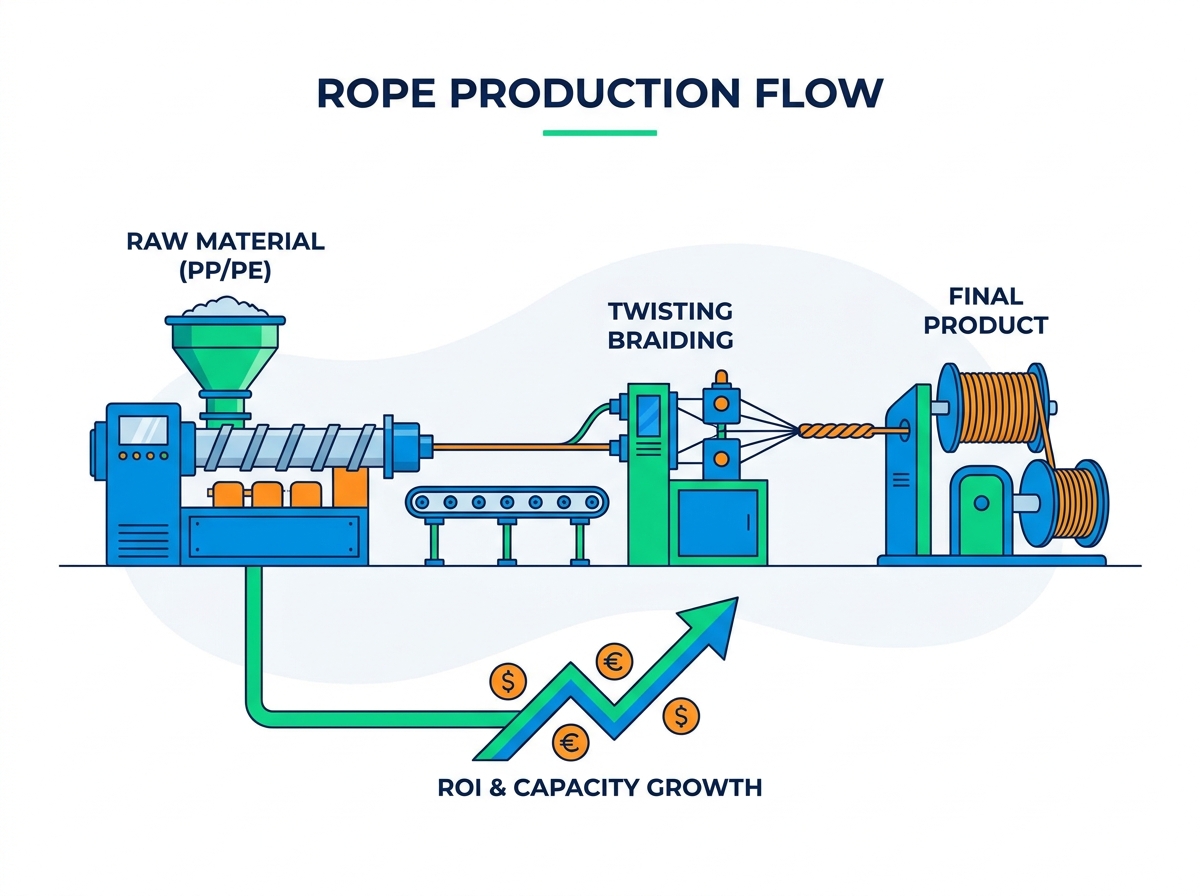
Transforming raw, granular plastic resin into heavy-duty, industrial-grade ropes requires a precise mechanical workflow. Demystifying this journey is vital for optimizing plant efficiency, reducing material waste, and maintaining strict quality control protocols.
The manufacturing journey begins at the hopper of the extruder. Virgin or high-grade recycled granules feed into a heated barrel housing a rotating screw. Temperatures must be dialed in precisely, typically between 200°C and 260°C. If the heat is too low, the melt is inconsistent. If it is too high, the polymer degrades. The molten plastic pushes through a precision-engineered die head, emerging as continuous monofilament yarns. These yarns are immediately quenched in a long water cooling tank. Following this rapid solidification, heated stretching rollers align the internal polymer molecules. This critical stretching phase drastically increases the tensile strength of the monofilament before it winds onto bobbins.
A single yarn lacks the structural integrity needed for industrial applications. Once individual yarns are spooled, operators transfer the bobbins to a ring twister machine. The twister gathers multiple individual yarns and spins them together at incredibly high speeds. The applied tension and specific twist level dictate the initial flexibility and load-bearing capacity of the resulting strand.
The core of the operation takes place within the structural forming equipment. Here, three or four of the previously twisted strands feed simultaneously into a specialized rope making machine. Utilizing fundamental physics, the equipment twists these thick strands in the exact opposite direction of the initial yarn twist. This counter-twisting mechanism balances the internal torque. It locks the strands together to create a stable, finished rope that will not unravel under heavy loads.
The final operational phase involves preparing the continuous rope for commercial distribution. The finished product pulls continuously from the forming machine and feeds directly into automated packaging systems. Depending on target market demands, the rope can be tightly wound onto large wooden spools for wholesale buyers, coiled into smaller hanks for retail hardware stores, or shrink-wrapped in bulk.
Building a seamless production flow requires selecting the right combination of machinery. Every component must be meticulously sized and synchronized to prevent costly bottlenecks on the factory floor.
As the foundational machine of the entire facility, the extruder dictates your baseline product quality. Investors should prioritize models featuring automatic PID digital temperature controls and high-quality alloy steel screws. Furthermore, the ring twister dictates the production speed and structural integrity of your internal strands. High-speed twisters equipped with variable frequency inverter controls allow operators to adjust the twist per meter precisely.
This heavy-duty equipment physically constructs the final product. When selecting your core machinery, it is highly recommended to source commercial rope manufacturing equipment that aligns perfectly with your target diameter range. Modern iterations should feature low-noise operation, variable speed drives, and automatic stop mechanisms that instantly halt production if a strand breaks.
To help visualize the equipment scaling, here is a practical selection guide based on standard industry parameters:
| Machine Category | Target Rope Diameter | Primary Industry Application | Key Engineering Features |
|---|---|---|---|
| Small-Diameter Rope Maker | 3mm - 12mm | Agricultural twine, retail hardware, light packaging | High spindle RPM, rapid output, compact footprint |
| Mid-Range Rope Machine | 14mm - 32mm | General logistics, fishing lines, utility tie-downs | Balanced torque, advanced inverter speed controls |
| Heavy-Duty Marine Maker | 40mm - 60mm+ | Mooring hawsers, deep-sea netting, heavy maritime | Massive structural frame, high-torque motors, auto-stop sensors |
Proper logistical planning prior to purchasing heavy equipment prevents costly installation delays. A manufacturing plant must be structurally equipped to handle immense weight, high electrical loads, and the continuous physical movement of materials.
A standard mid-capacity setup generally requires a minimum of 300 to 500 square meters of floor space. Industry best practice dictates a U-shaped workflow. This logical progression minimizes the distance workers must manually transport heavy bobbins between stations, dramatically reducing physical fatigue.
Rope manufacturing is an inherently energy-intensive process. The extruder relies on high-wattage heating zones to melt dense polymers. Twisters and formers utilize heavy-duty industrial motors. A standard production line typically commands a total power capacity ranging from 100 kW to over 200 kW. Consequently, facilities must be wired with a robust and reliable 3-phase industrial power supply.
Despite significant advancements in automation, skilled human oversight remains essential. A standard production line typically requires 3 to 5 operators per shift. This team usually comprises one lead technician to monitor critical extruder temperatures, two machine operators to load bobbins, and a logistics worker to handle final packaging.
Your available initial capital and specific target market will dictate the appropriate scale of your operation. Entry-level setups are exceptionally well-suited for startup entrepreneurs or regional agricultural suppliers. These facilities typically yield between 1,000 kg and 1,500 kg per 24-hour cycle, focusing on smaller diameter ropes.
For enterprises targeting lucrative export markets or commercial fishing fleets, scaling up is imperative. These robust setups generate between 3,000 kg and 5,000 kilograms daily. To achieve these numbers, factories must deploy advanced heavy-duty marine rope machines, supported by multiple high-speed twisters feeding into a central forming unit. The upfront cost is substantial, but economies of scale drastically reduce the per-kilogram production cost.
Ongoing operational expenditures directly dictate your daily profit margins. Raw material procurement usually accounts for 60% to 70% of total production expenses. Because synthetic cordage is sold strictly by weight, optimizing the extrusion process to eliminate scrap directly inflates the bottom line. Factories operating on a continuous 24-hour schedule maximize machine utilization. Under these optimized conditions, most industrial facilities project a break-even point and full ROI within 12 to 18 months.
The long-term success of your production line relies entirely on mechanical durability and the professional integrity of the manufacturer. Before committing capital, ensure the manufacturer holds recognized international quality certifications. Prioritize suppliers that transparently utilize globally recognized components.
Machines engineered with Siemens PLC control systems, Omron electronics, and Schneider frequency inverters offer vastly superior longevity compared to generic units. Procuring reliable rope manufacturing equipment is the beginning of a long-term partnership. Verify that the supplier provides comprehensive remote video troubleshooting and maintains a highly responsive supply chain for critical spare parts.
Setting up a complete plastic rope production line is a highly rewarding industrial venture backed by strong global demand and excellent profit margins. Ultimate success relies heavily on deeply understanding the multi-stage manufacturing process, selecting the appropriate equipment capacity, and optimizing your factory layout.
Whether you are launching a modest local supply operation or architecting a massive commercial export factory, investing in high-quality, durable machinery forms the absolute foundation of your business longevity. Ready to transform your manufacturing ambitions into reality? Visit https://en.cnrm.net to explore industry-leading machinery, request a customized equipment quote, and get a comprehensive ROI projection tailored to your specific operational needs.
Yes. Most modern extruders and forming machines are engineered for high versatility. By simply adjusting the thermal heating zones on the extruder barrel and swapping the raw material granules in the hopper, operators can seamlessly transition between manufacturing different polymer ropes without investing in entirely separate production lines.
Absolutely. Many cost-conscious manufacturers utilize high-quality recycled granules to significantly lower daily production overheads. However, ropes manufactured from virgin materials consistently yield higher tensile strength and a superior glossy appearance. A calculated blend of virgin and recycled material is standard industry practice to balance cost efficiency with structural quality.
A 3-strand rope is the ubiquitous industry standard, offering an excellent balance of tensile strength, flexibility, and cost-effective production. In contrast, a 4-strand rope typically incorporates a central core, making the final product slightly heavier, rounder in its physical profile, and highly resistant to surface abrasion.
For a standard, end-to-end production line encompassing the extruder, ring twisters, rope maker, and automated packaging units, you should secure a minimum of 300 to 500 square meters. This footprint ensures adequate spatial clearance for a linear or U-shaped machinery layout, safe movement of operators, and sufficient staging areas for inventory.
They are highly manageable provided your team adheres to strict, regular maintenance schedules. Critical upkeep tasks involve thoroughly lubricating heavy-duty gears, routinely inspecting the extruder screw for carbonized polymer buildup, and ensuring high-speed twisting spindles remain entirely free of dust and plastic debris.
The plastic monofilament extruder is universally the most expensive and technologically complex piece of equipment within the facility. It requires immense precision engineering to melt, stretch, and quench the plastics accurately. Its overall performance directly dictates both the structural quality and output speed of the yarn.
Power consumption varies based on the scale of the operation, but a complete standard production line typically requires between 100 kW and 200 kW of installed power. The extruder heating zones draw the most electricity, followed by the heavy-duty motors in the twisting and forming machines. A stable 3-phase industrial power grid is absolutely essential.
A typical mid-sized production line requires 3 to 5 skilled operators per shift. This usually includes one lead technician managing the extruder parameters, two operators handling the transfer of bobbins to the twisters and rope makers, and one or two workers managing the final packaging and spooling stations.