
Views: 0 Author: Site Editor Publish Time: 2026-11-10 Origin: Site


Textile mill managers and production engineers face a persistent challenge when balancing yarn quality, throughput, and operational efficiency. Choosing the right machinery is critical, as twisting remains a defining step in binding fibers and enhancing yarn strength. While both ring and two-in-one twisting technologies pursue the same structural outcome, their mechanical execution leads to vastly different economic results. Selecting between these systems requires careful analysis of production scales, specific yarn counts, and the long-term goals of your facility. This guide provides an evidence-based comparison to help your procurement and engineering teams evaluate which technology aligns best with your operational requirements. By examining the mechanical principles and real-world performance metrics of each system, you can make an informed decision that drives productivity and quality in your manufacturing processes.
Twist Output: Ring twisting inserts one twist per spindle revolution, whereas two-in-one twisting inserts two, functionally doubling production speed for compatible yarn counts.
Application Fit: A standard or high efficiency ring twister machine excels in versatility, handling coarse, technical, and highly sensitive industrial yarns, while two-in-one machines dominate fine-to-medium apparel yarn production.
Operational Economics: Two-in-One systems reduce labor costs via larger package sizes and fewer knots, but require higher initial capital and precise tension control.
Total Cost of Ownership (TCO): Equipment selection should weigh energy consumption per kilogram of output against floor space limitations and maintenance intervals (e.g., traveler replacements in ring systems).
The ring twisting process remains a cornerstone of textile production due to its mechanical simplicity and versatility. A Ring Twister Machine utilizes a spindle, ring, and traveler assembly to insert twist into the yarn. During operation, delivery rollers feed the yarn through a guide, and the traveler winds the finished product onto a bobbin. However, this system faces a fundamental limitation: mechanical friction. The physical contact between the traveler and the ring creates heat and limits maximum spindle speeds. If you push the machine beyond its optimal speed, you risk frequent yarn breakage and excessive wear on machine components. In contrast, the two-in-one twisting mechanism employs a fundamentally different geometry known as the ballooning principle. In this system, stationary feed packages sit inside a rotating spindle. The yarn travels through the spindle rotor and then travels through the balloon guide. Because the yarn receives one twist between the tension device and the rotor, and a second twist between the rotor and the balloon guide, it achieves two twists per single spindle revolution. This design significantly reduces mechanical vibration and wear, offering a more efficient alternative to a traditional Yarn Twisting Machine when handling standard apparel yarns.
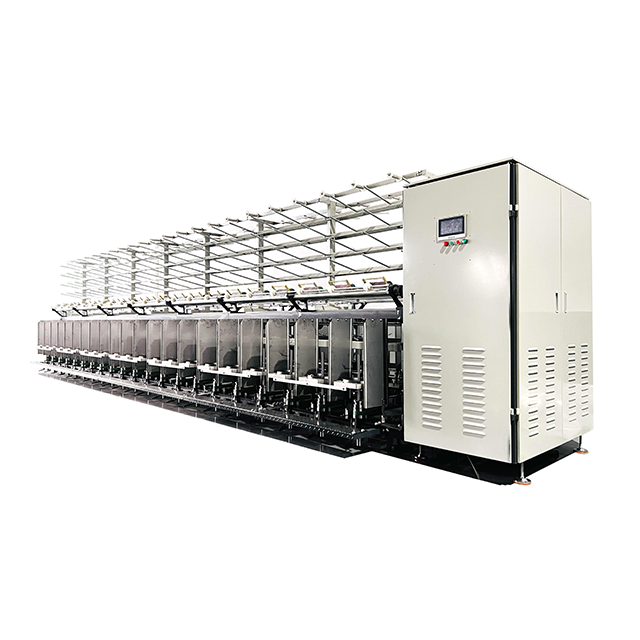
Production throughput varies significantly between these two technologies. A Two-in-One Twisting Winding Machine is designed for high-speed output, making it the preferred choice for massive production runs. The double-twist action effectively cuts production time, allowing you to meet higher volume demands. Conversely, for industrial applications involving heavy denier or technical plies, a High Efficiency Ring Twister Machine offers distinct advantages. These modern units utilize optimized motor drives and heavy-duty rings to minimize the performance gap, providing the strength required for industrial-grade yarns. Yarn quality also dictates your machine choice. Consider these performance factors:
Knot Frequency: Two-in-one systems support larger supply packages. These larger packages enable longer, continuous production runs, resulting in significantly fewer knots.
Tension Precision: Ring systems offer superior control over delicate yarns. They allow for fine-tuned tension adjustments that prevent snapping in fragile, low-twist blends.
Consistency: High-speed ballooning in two-in-one systems requires uniform yarn strength to maintain consistent quality throughout the process.
Comparison of Twisting Technology Capabilities | ||
Feature | Ring Twister | Two-in-One Twister |
|---|---|---|
Twists per Revolution | One | Two |
Speed Capability | Moderate | High |
Package Size | Smaller | Larger |
Ideal Yarn Type | Coarse / Technical | Fine / Medium Apparel |
Evaluating the economics of your machinery involves more than just unit pricing. Energy consumption is a key metric. Two-in-one machines often have a higher power draw per spindle because air drag occurs within the yarn balloon. However, when you calculate energy consumption per kilogram of produced yarn, the two-in-one system frequently proves more efficient for fine-count yarns. Labor requirements further define the operational profile of your mill. Ring systems necessitate frequent doffing and ongoing maintenance of rings and travelers. These labor-intensive tasks add up over time. Two-in-one systems reduce the need for constant operator intervention by extending doffing intervals and removing ring friction. While spindle rotors require specialized technical expertise to repair, the reduction in daily manual tasks often yields substantial long-term benefits. Finally, consider floor space. Two-in-one machines deliver higher output density, allowing you to maximize the productive area of your facility.
Choosing the correct equipment depends on your specific product portfolio and volume targets. Use this framework to guide your investment strategy:
Select a Ring Twister Machine if:
You produce coarse counts, fiberglass, sewing threads, or novel fancy yarns.
Your production schedule requires frequent changeovers between vastly different yarn profiles.
You prioritize precise control over delicate, sensitive yarn structures.
Select a Two-in-One Twisting Winding Machine if:
Your mill focuses on high-volume, continuous production of fine to medium count apparel yarns.
Reducing labor costs is a primary objective for your team.
Downstream processes like knitting or weaving demand long, knot-free packages for efficiency.
Rolling out new technology requires careful planning. First, evaluate your climate control systems. The ballooning process in two-in-one machines creates specific airflow patterns and heat. If your HVAC system fails to account for these changes, humidity levels may drop, causing the yarn to become brittle and prone to breakage. Second, invest in operator training. Moving from legacy ring systems to modern two-in-one units involves shifting away from traditional visual cues. Operators must learn to interpret digital diagnostic displays and monitor tension systems. Tension calibration is particularly critical; it relies heavily on the quality of upstream winding. Ensure your team understands that poor input package quality will directly impair the efficiency of your new high-speed machines. Lastly, avoid making decisions based solely on the initial price. Account for the long-term availability of OEM parts and the durability of spindle bearings to ensure sustainable operation.
Selecting between ring and two-in-one twisting technology is not about choosing a superior machine, but about aligning technology with your specific product portfolio. Ring systems remain unmatched for technical versatility and coarse yarn handling, while two-in-one systems dominate high-volume apparel markets. Before finalizing any equipment investment, conduct thorough pilot trials using your raw materials. This ensures the chosen machinery meets your performance standards. Engage with reputable manufacturers to analyze your specific operational needs and regional factors. By taking these strategic steps, you ensure your mill remains competitive, efficient, and ready to handle future production demands.
A: Yes, it can process fine counts. However, the production rate is typically lower, and the cost per kilogram is often higher. This makes it less economically viable compared to two-in-one systems for high-volume, fine-count production runs.
A: The higher cost stems from the complex spindle design and integrated precision tensioning devices. These components require careful manufacturing to ensure balance at high operating speeds, unlike the simpler mechanics found in ring-and-traveler systems.
A: It does not cause damage by design, but the ballooning process exerts higher dynamic tension on the yarn. If the yarn lacks sufficient single-end strength or if the tension capsule is incorrectly calibrated, you may experience higher breakage rates.
A: Modern high-efficiency models include individual spindle motor drives, automated doffing systems, and advanced ring metallurgy. These improvements significantly reduce friction and energy waste, narrowing the efficiency gap for applications where two-in-one systems might not be suitable.