
Views: 0 Author: Site Editor Publish Time: 2026-09-06 Origin: Site


Selecting the right synthetic fiber is a challenging B2B procurement task. You must balance high tensile strength against harsh environmental exposure. Saltwater and ultraviolet light rapidly degrade inferior materials. Achieving scalable cost-efficiency adds another layer of complexity to the decision.
Enter danline yarn. Manufacturers define it as an engineered polypropylene-based solution. The industry designs this material to outperform traditional monofilament fibers in heavy-duty applications. It offers unique structural advantages for intense industrial usage.
Technical buyers, engineers, and supply chain managers require clarity. You need an evidence-based framework for evaluating these materials. This article provides a structured approach for your procurement strategy. You will learn how to specify, test, and source this essential fiber. We will explore its core properties, manufacturing quality controls, and real-world applications.
Material Composition: Danline is an extruded polypropylene (often hybridized into poly-steel yarn) engineered for superior grip and breaking strength.
Core Advantages: Exceptional buoyancy (low specific gravity), zero water absorption, and high resistance to chemical degradation make it a premier marine fiber.
Primary Applications: Essential in commercial aquaculture (buoy lines, netting), industrial load binding, and civil engineering (erosion sediment control).
Manufacturing QA: Yarn quality is highly dependent on precision extrusion equipment, specifically draw ratios and thermal stabilization.
Sourcing Criteria: Buyers must evaluate suppliers based on verifiable UV stabilization data, tensile testing transparency, and production scalability.
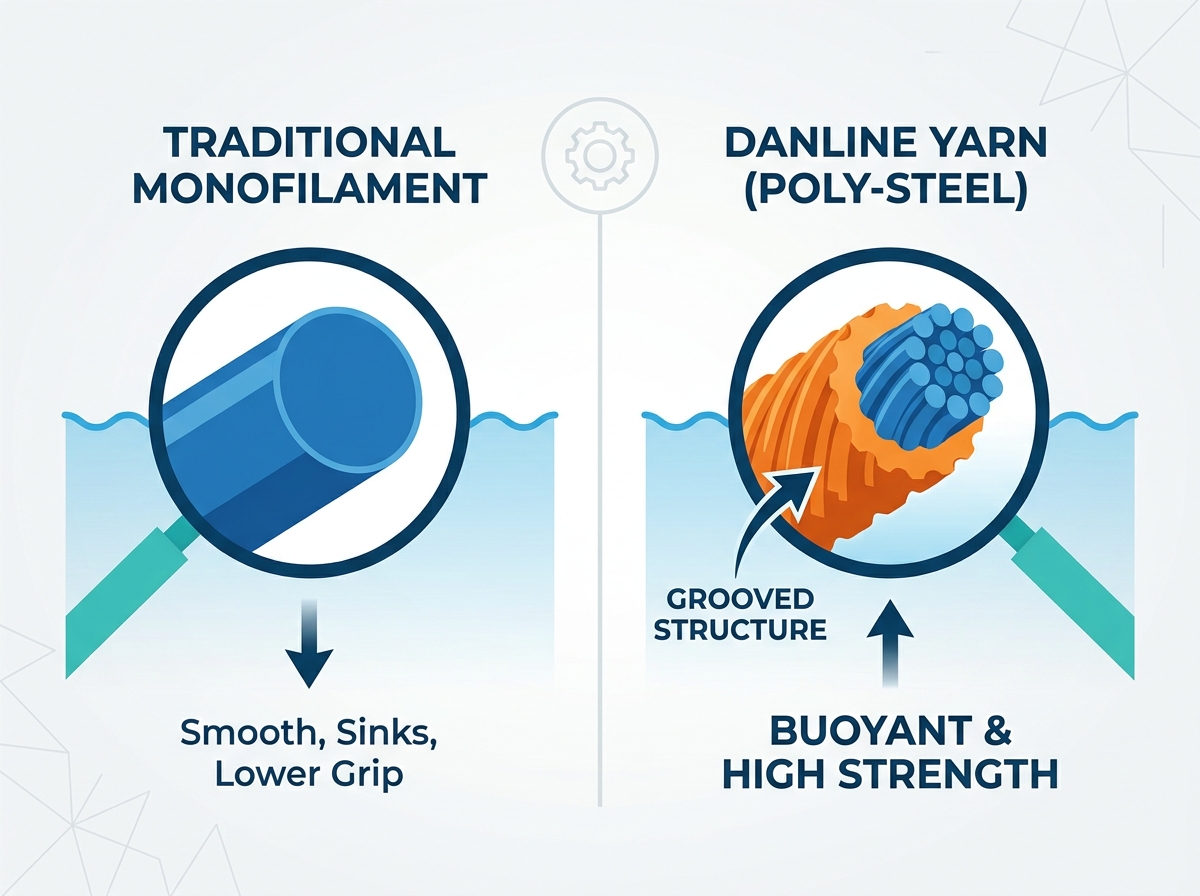
To make informed procurement decisions, we must examine structural differences. Danline possesses a distinct structural profile compared to basic polypropylene. Traditional monofilament yarns have a completely smooth, uniform exterior. Multifilament yarns consist of many thin, continuous strands twisted together. In contrast, manufacturers engineer this material to have a slightly textured, fibrillated nature. The extrusion process creates microscopic grooves along the filament axis. This unique geometry enhances friction and mechanical grip.
Sometimes buyers encounter hybrid terminologies during sourcing. You will often see it referred to as poly-steel yarn. This specific distinction occurs when manufacturers co-extrude the base polypropylene alongside high-density polyethylene (HDPE). This hybrid approach creates maximum tensile strength. The HDPE component adds stiffness and abrasion resistance. The base PP maintains essential flexibility and lightweight properties. It represents the highest tier of commercial rope materials.
Understanding this structural profile is vital for risk mitigation. The unique grooved cross-section prevents knot slippage. Standard smooth PP ropes frequently fail at the knot under heavy tension. The textured surface bites into itself when tied securely. This lock-in effect eliminates a critical failure point in marine and lifting operations.
Common Mistake: Do not assume all textured PP yarns are authentic danline. Some suppliers mechanically scuff cheap monofilaments to mimic the texture. True quality comes from specialized die plates during the extrusion phase.
Fiber Type | Surface Texture | Knot Retention | Primary Weakness |
|---|---|---|---|
Standard Monofilament (PP) | Completely smooth | Poor (High slip risk) | Fails under sudden knot tension |
Nylon Multifilament | Soft, fibrous | Excellent | Absorbs water, sinks, higher cost |
Danline (Extruded) | Grooved, fibrillated | Excellent | Requires UV stabilization additives |
Evaluating industrial materials requires strict attention to physical thresholds. The material acts as an exceptional high-strength rope yarn because of its tensile capacity. It boasts an incredibly high breaking strength relative to its weight. More importantly, it maintains a controlled elongation rate. Standard ropes either snap under shock or stretch uncontrollably. This engineered material stretches just enough to absorb sudden dynamic loads. It prevents catastrophic snapping during heavy weather marine operations.
Specific gravity dictates how a material behaves in wet environments. The specific gravity of this yarn sits at approximately 0.91. Water has a specific gravity of 1.0. This means the yarn naturally floats on the surface. Furthermore, it features zero water absorption. Nylon and natural fibers soak up moisture rapidly. This material retains exactly 100% of its dry breaking strength even when fully submerged. It never gains unmanageable water weight.
Outdoor industrial deployment mandates protection against sunlight. Unprotected polymers suffer severe ultraviolet degradation over time. The plastic becomes brittle and loses tensile capacity. Industrial-grade formulations must undergo UV stabilization. Technicians add specialized chemical UV inhibitors directly into the resin mix during extrusion. This internal shielding ensures reliable long-term performance under direct sunlight.
Chemical inertness acts as a baseline requirement for heavy-duty use. We look for materials resisting severe environmental attacks.
Alkali and Acid Resistance: It survives exposure to harsh cleaning chemicals and industrial spills.
Biological Immunity: The synthetic nature makes it impervious to marine rot and mildew.
Solvent Tolerance: It withstands incidental contact with fuels and common lubricants.
Best Practice: Always request ISO-certified tensile testing datasheets. Do not rely on generic supplier estimates. Verify the exact elongation percentage matches your dynamic load requirements.
The unique physical profile translates to massive utility across multiple commercial sectors. We see distinct industries adopting this material to solve environmental challenges. It replaces traditional options by offering superior longevity.
Aquaculture and Marine Operations: Mooring lines, buoy lines, and commercial fishing nets heavily rely on this material. It serves as an ideal marine fiber due to its inherent buoyancy. Floating ropes prevent accidental fouling on the rocky seabed. This reduces gear loss and mechanical damage. Furthermore, the complete rot-resistance dramatically lowers replacement cycles for fishing fleets.
Civil Engineering and Erosion Control: Construction teams utilize it for silt fences and geogrid stabilization. We see it deployed in extensive erosion sediment control systems. It wins in this sector because of extreme durability. The material survives highly abrasive, soil-heavy environments without degrading. It secures earthworks securely over multi-year projects.
Industrial Material Handling: Logistics companies specify it for heavy-duty packaging and cargo nets. Load binding requires supreme reliability during transit. The material wins here due to excellent knot holding capability. It also demonstrates strong resistance to friction heat generated during tensioning processes.
Each sector leverages the zero water absorption trait differently. Fishermen value the constant weight for easier hauling. Construction crews value the stable breaking strength during torrential rain. Logistics teams rely on predictable tension metrics regardless of weather conditions.
Yarn quality depends entirely on the precision of the manufacturing machinery. The extrusion process follows a strict thermal and mechanical sequence. The operation begins by melting raw polypropylene resin pellets. The machine extrudes the molten polymer through specialized die heads. Next, a water bath rapidly quenches the hot strands to solidify them. The system then draws and stretches the filaments. Finally, automated winders spool the finished product.
Several critical equipment variables dictate the final quality. Thermal control acts as the primary quality safeguard. Modern extruder machines utilize highly precise temperature zones. Improper heating degrades the polymer chains immediately. Strict thermal regulation prevents brittleness and ensures maximum molecular integrity. Any temperature fluctuation creates weak spots along the spool.
The draw ratio represents the most vital mechanical setting. This stretching phase forces the random molecular chains to align longitudinally. Optimal alignment directly dictates the final tenacity of the yarn. Too little stretching results in weak, overly elastic rope. Too much stretching creates a rigid filament prone to snapping under lateral pressure. Advanced machinery maintains the draw ratio within incredibly tight tolerances.
Buyers must verify manufacturer capabilities before signing contracts. The downstream rope-making process requires flawless input material. Ask suppliers for comprehensive data on their winding precision. Tension inconsistencies during winding cause severe tangles later. You should also demand continuous filament testing records. This mitigates the risk of breakages when feeding the yarn into standard twisting and braiding equipment.
Common Mistake: Buyers often ignore the machinery brand used by the supplier. Second-rate extrusion lines cannot maintain consistent draw ratios. Verify the factory employs modern, sensor-monitored stretching ovens.
Sourcing reliable materials requires strict vendor qualification. You must mandate comprehensive testing and compliance documentation. Require suppliers to provide certified datasheets from independent laboratories. Look for ISO testing standards covering break strength and UV stability. Reject marketing claims of absolute invincibility. Professional manufacturers provide stated lifespan limits under direct sunlight. You need evidence-based performance guarantees.
Customization capabilities separate premier vendors from basic resellers. Ensure your chosen manufacturer can adjust technical specifications. You might require specific denier settings or adjusted tenacity for niche applications. Color-matching also plays a role in maritime safety regulations. The ability to customize PP danline proves the supplier actually controls the extrusion process. Simple brokers cannot alter physical manufacturing parameters.
Evaluate production scalability and lead times early in negotiations. Compare the supplier’s active production capacity against your long-term demands. Ask how many extrusion lines run concurrently at their facility. Small factories easily handle sample orders but fail during peak seasonal demand. Securing an adequately scaled partner prevents severe supply chain bottlenecks.
Pricing discussions require a specific analytical lens. Frame your cost analysis around cost-per-meter rather than cost-per-kilo. Polypropylene acts as an exceptionally lightweight polymer. A one-kilo spool of this material yields significantly more running meters than nylon or polyester. Assessing yield per spool reveals the true economic advantage of the material.
Evaluation Metric | Acceptable Standard | Red Flag Indicator |
|---|---|---|
UV Certification | ISO certified weathering test reports | Vague "UV Protected" marketing claims |
Pricing Model | Transparent cost-per-meter yield data | Refusal to discuss yield rates |
Production Scale | Multiple active extrusion lines | Cannot handle rapid MOQ increases |
Customization | Adjustable denier, tenacity, and colors | Fixed catalog items only |
Specifying the right synthetic fiber comes down to precise alignment. You must match physical properties like buoyancy, tensile strength, and knot retention with strict manufacturing quality controls. High-grade materials prevent catastrophic failures in harsh marine and industrial environments. Success relies entirely on verified draw ratios and proper thermal stabilization during extrusion.
Your next steps require rigorous vendor vetting. Request detailed technical datasheets immediately. Order sample spools to conduct in-house stress testing on your own machinery. Finally, demand verifiable UV-inhibitor certifications before committing to bulk contracts. These actionable steps ensure long-term reliability and secure your supply chain.
A: The primary difference lies in water interaction and cost. Danline floats, absorbs zero water, and proves highly cost-effective for large-scale operations. However, it features a lower melting point than nylon. Nylon sinks, absorbs moisture, and loses a percentage of its breaking strength when wet.
A: Lifespan heavily depends on the percentage of UV stabilizers added during the initial extrusion phase. You should expect evidence-based lifespan estimates spanning 2 to 5 years under harsh, direct sunlight conditions. Avoid suppliers making indefinite longevity claims without ISO weathering test data.
A: Yes. Manufacturers design its structural profile to feed seamlessly into standard twisting and braiding equipment. The grooved texture grips well on industrial spools. You may simply require minor tension calibration on your machinery to accommodate the specific denier of the new material.